The Story of Thorn (þ)

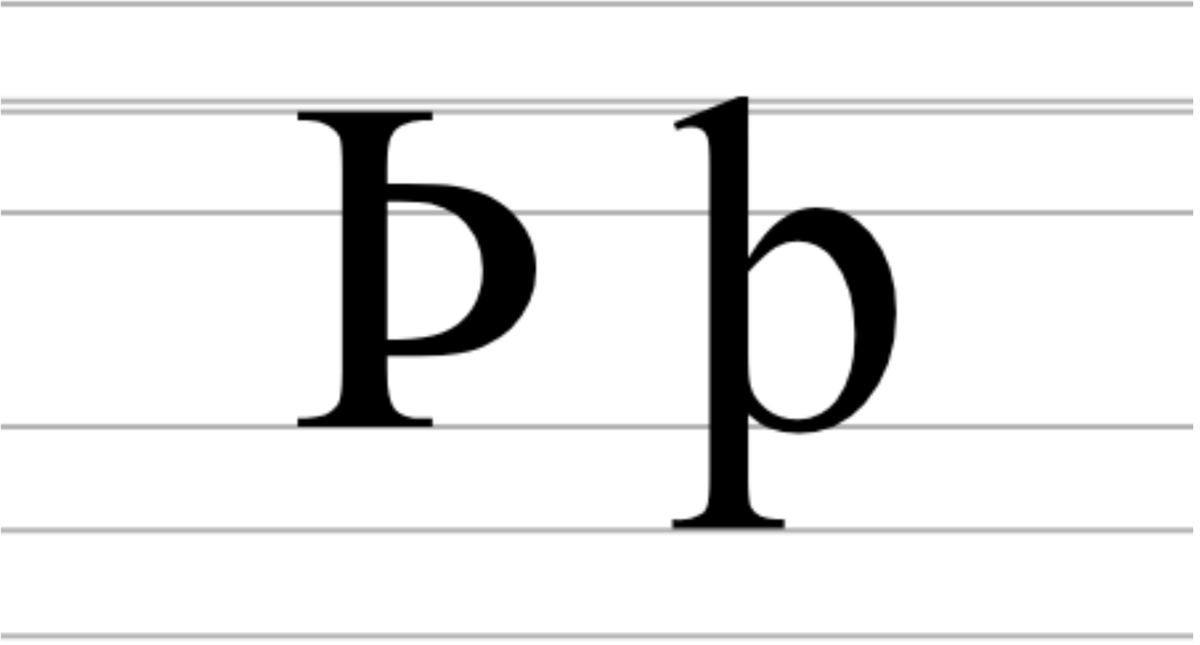
English is a consistently evolving language. As time progresses, vocabulary shifts, new vernacular develops, and even the alphabet may be subject to change. Although alterations within alphabets may seem unnatural or unheard of, one of the prime examples of these alphabetized changes was the letter “thorn,” written as þ. This letter was utilized primarily throughout Old and Middle English in order to portray the “th” sound used in words such as there, the, that, and those. In modern-day English, there are two letters, t and h, that are combined to represent the “th” sound, but for centuries, individuals had used a separate letter to distinguish the sound. At its root, the letter thorn originated from the runic alphabet, used by early Germanic peoples.
When Old English began to be documented using the Latin alphabet, there were specific sounds that simply could not be replicated within the set of Latin letters and their fixed sounds, one being the “th” sound. Due to the lack of alternatives for this specific combination of letters, English kept utilizing thorn to combat that dearth in all aspects of linguistic use. For instance, writers were able to illustrate this sound unique to the English language, without having to improperly depict it within another language through inaccurate spelling or pronunciation. Having letters specific to the English language allowed for a broader usage of distinctive sounds that could not be replicated in other languages.
However, the usage of thorn declined at a slow rate, mostly influenced by varying forms of technology and culture instead of any changes in pronunciation itself. Furthermore, as printing became more prominent within civilizations across the globe, English spelling started to become more standardized, meaning certain letters that posed an inconvenience in production were more likely to be left behind. Thus, thorn gradually began to be replaced by “th,” simply due to the major changes within writing systems, not because of the necessity of the sound itself. This transition highlights an important misconception within linguistic change. It is widely believed that certain letters or sounds die out due to pronunciation shifts or language change, but in cases such as the letter thorn, linguistic changes occur due to printing constraints, leading to shifts within the technology and materials available at the time.
One common instance of the letter thorn that is still seen within society and language as a whole today is phrases including or beginning with the term “ye,” such as “ye olde.” The origin of this phrasing lies within medieval scripture, as the letter thorn subtly began to resemble the letter y. Individuals analyzing these scriptures in the future misinterpreted the letter, claiming it to be an actual y, therefore resulting in the current misconception of what was originally intended to be read as “the,” as “ye.” In some instances, the word “ye” is viewed as an almost archaic, ancient way of how people used to say “the,” whereas in reality, phrases like “ye olde” were actually being pronounced as “the olde” the entire time. Thus, the change and ultimate decline of certain aspects of language can impact the way language is interpreted and understood over time through shifts in writing, for instance, impacting future generations’ understanding of history and the past overall.
In summation, the disappearance of once-utilized letters such as thorn demonstrates how language changes may often stem from historical misinterpretations, technological standardization, or material conditions. Letters can disappear due to changes in writing style or production, meaning that letters that are simpler to produce through forms of printing may overpower letters that are harder to replicate on paper. English still has the sound “th” implemented within thousands of its words, except for the singular letter that once represented it. Although letters within today’s alphabets, not just in English, but all across the world, may seem solidified, they are just as easily subject to change as pronunciation, grammar, and vocabulary are. Thus, thorn serves as a reminder of how the English language endured alphabetical change through shifts in printing, and how seemingly insignificant aspects of language carry immense historical weight.