The Great Vowel Shift: The Change That Broke English

Languages are presumed to gradually transform, altering in subtle, almost imperceptible ways as time progresses. However, not all linguistic change is predictable and moderately paced. Between the 15th and 17th centuries, English went through an extremely prominent linguistic transformation that altered the way the language sounded at its root. This shift, referred to as the Great Vowel Shift, established new grammatical systems and reconstructed the pronunciation of long vowels across the English language. The result of this event is one of the most defining elements of modern-day English, fostering a disconnect between spelling and sound that persists in shaping the way the language is spoken, read, written, and learned today.
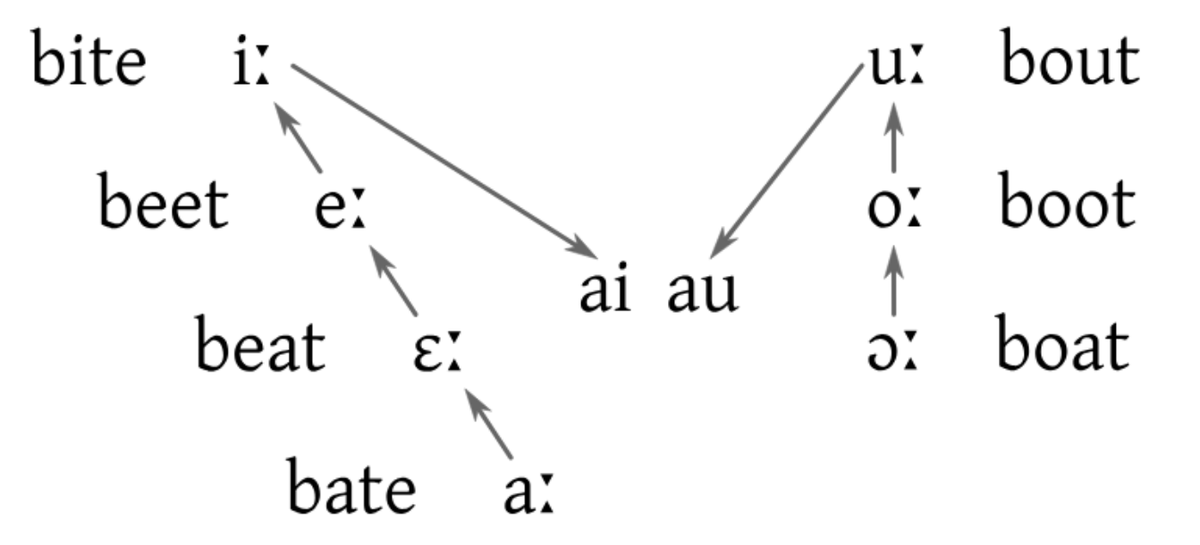
Prior to this transformation, English vowels were pronounced in direct correlation to their written form, meaning that words like “bite” and “meet” would have sounded more like the words “beet” and “mate” in spoken English today. However, during the Great Vowel Shift, these vowel sounds travelled upward in the mouth in a partially systematic way. Certain vowels became diphthongs, which were sounds formed by the combination of two vowels in a single syllable, whereas others shifted in quality, separating all of them from their original phonetic values.
This shift is especially unusual as it does not have a clear, singular cause. In contrast to other language changes rooted within conquest or authority, the Great Vowel Shift seems to have appeared from a convoluted mix of regional variation and the inherent instability of fixed linguistic systems. This transformation is particularly significant as it took place at the same time that English spelling was turning into a more standardized practice. The increased utilization of print, specifically after the spread of the printing press, began to fix written forms of words regardless of the fact that their pronunciations were changing. Consequently, spelling preserved more historical forms of English while spoken word continued to progress. This is why modern English is comprised of words like though, through, and tough, which, on paper, seem similar, but when spoken aloud, sound completely different.
The Great Vowel Shift also highlights the reason as to why earlier forms of English seem almost unrecognizable today. Scriptures from English during the Middle Ages, and even texts from the early modern period, tend to come across as more distant than they actually are. The English language itself has not changed beyond simple recognition in vocabulary and structure; however, its sound has changed so dramatically that it comes across as an entirely different language. This alteration is increasingly evident within the works of the esteemed English playwright and poet, William Shakespeare. Although a majority of Shakespeare’s vocabulary is fairly understandable and familiar, his language would have sounded vastly different to his original audience, closer in some aspects to earlier forms of English than to modern speech.
Overall, the Great Vowel Shift demonstrates how language is never fixed, even at its foundations. Pronunciation, which usually feels like a natural and fixed phenomenon, is actually subject to change just as much as grammar and vocabulary are. The inconsistencies within the English language illustrate its historical background in which spoken and written English diverged paths. Therefore, the English language as a whole embodies the unpredictable and complex nature of linguistic transformation.