Undeciphered Languages: Mysteries of the Past

Everyone loves a secret, and in a way, undeciphered languages are the quintessential secret for historians, archaeologists, and linguists. Though we have made significant progress in decoding many ancient languages, there are still dozens of preserved yet untranslated inscriptions from around the world we have yet to understand. There is an undeniable allure to these cultures, stories and lives that remain tantalizingly close, yet just out of reach.
Despite the efforts of professional and amateur paleographers (people who study historical writing systems), there’s no definitive translation or decryption for many ancient languages. This is because the process of translation isn’t as straightforward as we would like it to be. In some rare cases, scholars have access to essential artifacts that enable translation, like the Rosetta Stone for Egyptian hieroglyphics. For most languages, however, archaeologists have not recovered a direct, one-to-one translation reference—also known as a bilingual key. While attempts at deciphering languages without these keys have been conducted, none have been conclusive as of now.
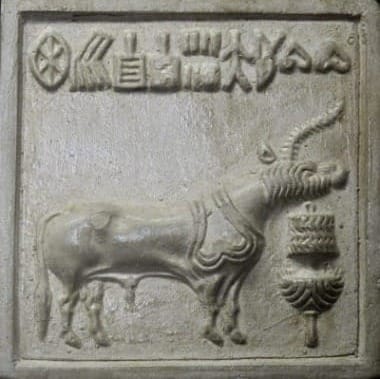
One of the oldest undeciphered writing systems is the script of the Indus Valley Civilization, which dates back to the Bronze Age. Archaeologists have uncovered glimpses into their culture through excavations, but we cannot make definitive conclusions without an understanding of their language. We know the Indus people had extensive urban planning from their uniformly made bricks, multi-story cities, and complex sewage and sanitation system. They had public baths and plumbing before the Romans had even begun to dream of aqueducts. We also know that the largest building in the Indus city of Mohenjo-daro was one of these public baths, suggesting the cultural importance of hygiene and bathing.
Apart from the buildings and infrastructure, archaeologists have discovered many artifacts with the Indus script, including small stone tablets called seals, which were used to ratify transactions. These seals are a key source of the Indus script and writing system, but they also feature designs depicting humans, animals and monsters. Another important artifact is the famous priest-king statue excavated at Mohenjo-daro, providing insight on potential social and religious structure. Perhaps the most important discovery regarding the Indus people is that they were most likely peaceful: despite surveying over 1,500 sites, archaeologists have found very few weapons. Ultimately, while these facts seem to paint a picture of Indus culture and society, they are really only glimpses through a keyhole. The translation of the Indus language, though, could allow us to read the thousands of inscriptions we have and completely open the door to understanding their civilization.
Another text historians and archaeologists are unable to translate is the Voynich manuscript, an esoteric, illustrated codex from 15th century Italy. The script of the manuscript is completely unique, never used in any other discovered texts. Besides the unusual writing, the manuscript also contains many bizarre drawings of plants, women, and cosmological diagrams. This leads some to speculate that the Voynich manuscript is a work of obscure folklore or speculative mythmaking—in other words, medieval science fiction. Some theorize that the Voynich manuscript’s script is an elaborate code or cipher. It could also be an early historical example of a constructed language, like the fictional Klingon from Star Trek or Elvish from Lord of the Rings. Others believe the manuscript is a hoax, a deliberately meaningless series of repeating symbols. Despite the many theories, we may never discover whether the manuscript has any meaning. Yet the allure of a medieval manuscript possibly containing some ancient secrets is what inspired professional and amateur cryptographers to make valiant attempts at deciphering the script.
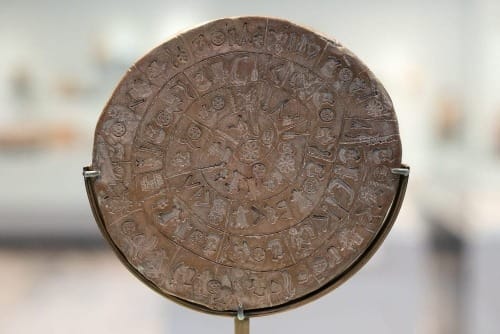
The last example of an untranslated text is the Phaistos disc, a clay disc inscribed with mysterious symbols dating back to the Minoan Bronze Age. Some interpret the language as a form of Greek, others assert it is related to the scripts Linear A and B, two scripts used in the ancient Minoan and Mycenaean civilizations respectively. Some of the more interesting interpretations of the Phaistos disc are that it was a calendar, an astronomical document, or even a board for an ancient board game. Whether the Phaistos disc contains an unknown language or represents something else entirely, if understood, it could provide valuable insight into the beginnings of ancient Greek civilization.
On a final, poignant note, the binding element throughout these stories relates to the idea of sonder: a neologism coined by writer John Koenig that captures the realization that every person lives in their own, unknowable world. Perhaps we can’t fully grasp the foreign, ancient worlds of others, but we can reach through space and time to attempt to see through their eyes, to read and speak their words. We end up learning to see ourselves differently, not merely as characters in our own isolated stories, but as part of the broader process of history and the collective whole of human culture.