Tamil: One of the Oldest Living Classical Languages
How a Language Preserved People Through Empire and Erasure
Tamil is not merely an ancient language; it is a living heritage and legacy. While many classical languages survive only through archives, translation, or ritual, Tamil is continuously spoken, sung, and written by over seventy million people in today’s world. Its sustenance over more than two millennia is not simply a "coincidence." It is the result of cultural perseverance in the midst of colonization and systematic eradication. To be an active Tamil speaker is not simply a form of communication, but participation in a perpetual lineage of identity.
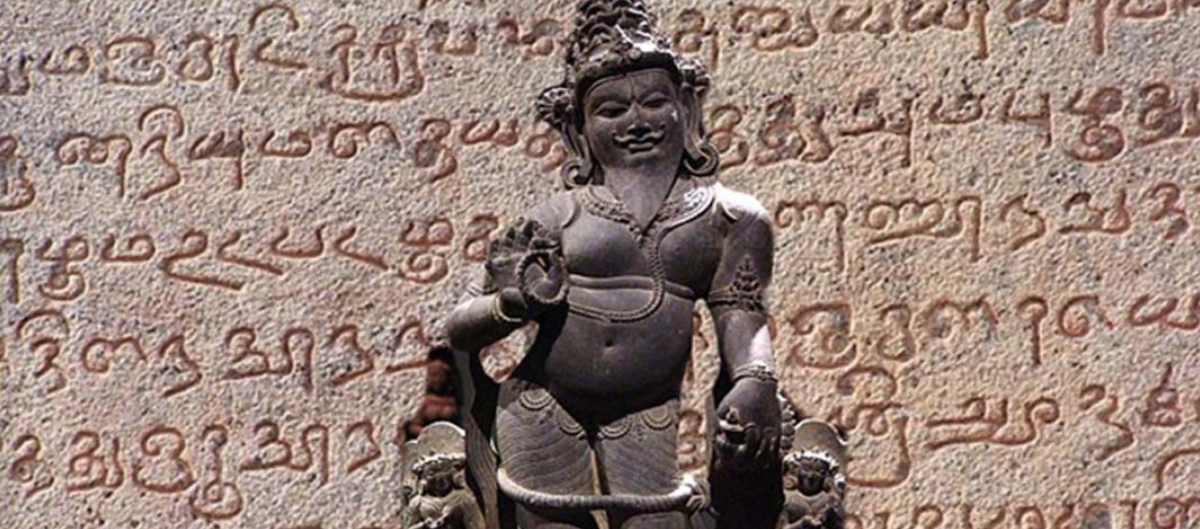
The earliest Tamil literature, the Sangam corpus (c. 300 BCE—300 CE), already establishes a highly developed civilization. Scriptures such as the Akanāṉūṟu and Puranāṉūṟu delve into themes of warfare, governance, ethicality, love, and grief with extreme emotional nuance and philosophical depth. The Tirukkural, written by Thiruvalluvar, prevails as one of the most powerful moral texts in the world, providing wisdom on politics, human demeanor, and virtue with extreme ubiquity. Furthermore, scholars Kamil Zvelebil and George L. Hart have illustrated that these writings exhibit Tamil as not a subsidiary regional language, but as a completely independent literary tradition shaped by its civilians rather than forced upon by conquerors.
This freedom would become pivotal as outside forces arrived. Under British colonial rule, English was implemented as the language of law, authority, and education. At the time, language wasn’t only used as a form of communication, but also as a form of dominance and control. To honor English was to disparage indigenous identities, culture, and knowledge systems. Despite these controlling forces, Tamil communities rejected linguistic expulsion through means of education movements, literature, and cultural preservation. So, although colonial governance and hierarchies attempted to portray Tamil as outdated and subservient, it remained central to social life.
However, their struggle did not end with independence. During the mid-twentieth century, efforts to impose Hindi as a national language in India resulted in mass protests within Tamil Nadu, a South Indian state. These anti-Hindi resistances were not simply in regard to vocabulary or grammar, but were about cultural preservation and survival. Historian Sumathi Ramaswamy illustrates these protests as a form of linguistic nationalism, in which Tamil served as a symbol of decorum, honor, autonomy, and resistance to cultural standardization. For many, Tamil was directly in correlation with defending their right to exist as themselves.
Tamil literature has extensively proved this refusal to be erased. The Bhakti movement poets, Andal and Appar, chose to write divine poetry in Tamil rather than in Sanskrit, challenging religious hierarchies and making sacred expression accessible to all people. Their writings transferred cultural supremacy from elite infrastructures to the general public, making language a haven of inclusion rather than exclusion.
What makes Tamil sensational is not just its ancientness, but its adaptability. Tamil has gone from leaf manuscripts to digital programs, from small regions to the globe, from temple scriptures to movie theaters. In Malaysia, Sri Lanka, Singapore, and all throughout the continents of North America and Europe, Tamil progressively passes down through generations. This active continuation and preservation of Tamil illustrates that progress and continuity are not opposing elements and can act hand in hand.
In today’s society, where thousands of languages are vanishing, Tamil acts as a powerful refutation. The language highlights that cultures do not disappear because they are weak, but because they are silenced and oppressed. Tamil has continuously fought against that erasure. To speak Tamil is to hold resistance, memory, belonging, and identity in each word. It is not just a language older than empires, but a language of the people who withstood them.